Beef Heart for Dogs: The Richest Natural Source of Taurine (And Why That Matters Right Now)
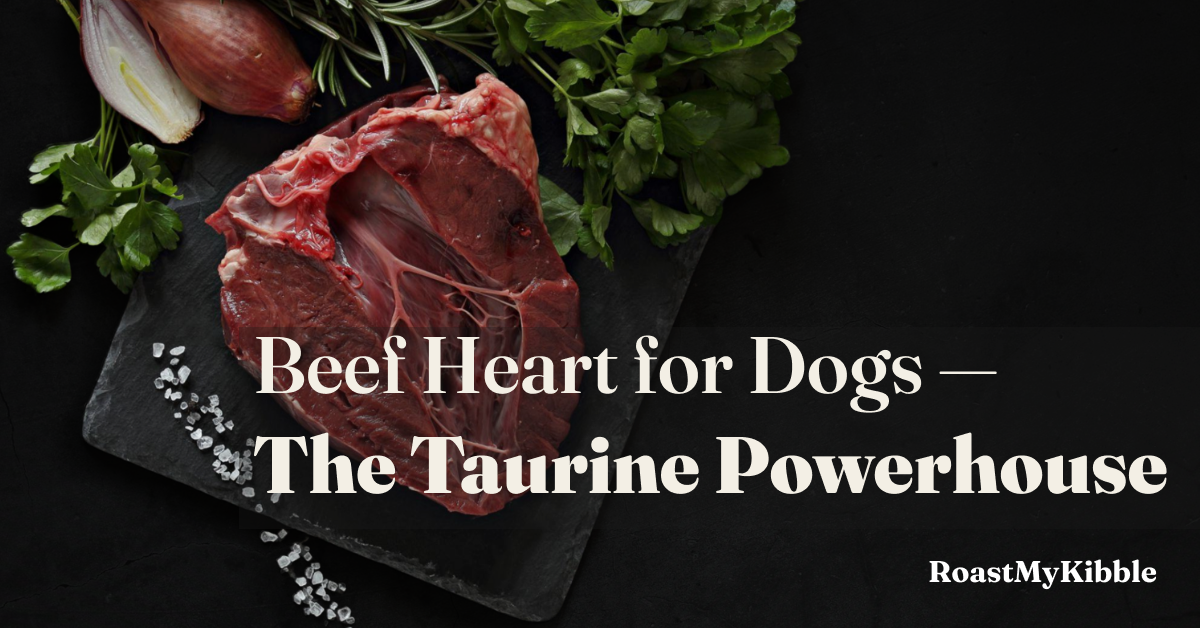
If liver is the multivitamin, heart is the cardiac specialist.
Beef heart occupies a strange category in canine nutrition. Technically, it's a muscle meat. The AAFCO definition classifies it that way. The 80/10/10 raw feeding framework counts it toward the muscle portion, not the organ portion. But nutritionally, heart behaves like nothing else in the muscle category. It's packed with compounds that are barely present in chicken breast, ground turkey, or even premium steak cuts—compounds that directly support the most important muscle in your dog's body.
And right now, with the FDA investigating a potential link between grain-free diets and dilated cardiomyopathy, with thousands of dogs developing heart disease in breeds that shouldn't get it, and with taurine deficiency sitting at the center of every leading hypothesis—heart meat has never been more relevant.
This is the deep dive on beef heart. What's in it, why taurine matters, why cooking destroys the thing you're trying to get, and how to put heart into your dog's bowl without touching a raw, glistening slab of it if you don't want to.
What Nutrients Are in Beef Heart?
Beef heart is exceptionally rich in taurine, Coenzyme Q10 (CoQ10), B vitamins, iron, and zinc. It's classified as muscle meat but behaves nutritionally like an organ—dense with compounds that support cardiac function, energy metabolism, and cellular health.
Here's the nutritional profile per 100 grams (3.5 ounces) of raw beef heart:
| Nutrient | Beef Heart (100g) | What It Does for Your Dog |
|---|---|---|
| Taurine | ~65 mg | Cardiac function, bile acid production, vision, immune regulation |
| CoQ10 | ~3-5 mg | Cellular energy production, antioxidant protection for the heart |
| Protein | ~17g | High-quality, highly digestible muscle-building protein |
| Iron | ~4.3 mg | Red blood cell production, oxygen transport |
| Zinc | ~1.7 mg | Immune function, skin health, wound healing |
| Vitamin B12 | ~6.2 mcg | Nervous system function, red blood cell formation |
| Selenium | ~22 mcg | Thyroid function, antioxidant protection |
These numbers don't pop off the page the way liver's 566x vitamin A advantage does. But don't mistake subtlety for insignificance. The compounds that make heart valuable—taurine and CoQ10—are almost entirely absent from standard muscle meats. Chicken breast contains negligible taurine. Ground beef contains some, but far less than heart. And CoQ10 is concentrated almost exclusively in organs and cardiac muscle.
Heart is a targeted nutritional delivery system. It's not trying to be a multivitamin. It's trying to support the cardiovascular system specifically, and the compounds it delivers do exactly that.
What Is Taurine and Why Does Your Dog Need It?
Taurine is a sulfur-containing amino acid critical to canine cardiac function, vision, bile acid production, and immune regulation. Dogs can synthesize taurine from dietary precursors (methionine and cysteine), but this synthesis may be insufficient when diets are low in animal protein or high in compounds that interfere with taurine metabolism.
Taurine is not one of the amino acids that builds muscle. You won't see it on a protein supplement label. It functions differently—as a regulator of cellular processes rather than a structural component.
In the heart, taurine regulates calcium handling within cardiac muscle cells. Without adequate taurine, calcium signaling becomes disordered, and the heart's ability to contract and relax efficiently degrades. Over time, this manifests as dilated cardiomyopathy—a thinning and weakening of the heart muscle that eventually leads to congestive heart failure.
Taurine is also essential for:
- Vision: Taurine is concentrated in the retina, where it protects photoreceptor cells from oxidative damage.
- Bile acid production: Taurine conjugates with bile acids, enabling fat digestion.
- Immune function: Taurine acts as an antioxidant in white blood cells, protecting them during immune responses.
Dogs can synthesize taurine from methionine and cysteine—amino acids found primarily in animal tissue. But synthesis rates vary by breed, size, age, and diet composition. Large breeds appear to synthesize taurine less efficiently than small breeds. Some lines of Golden Retrievers have a genetic predisposition to taurine deficiency. And certain diets—particularly those heavy in plant protein and low in animal tissue—may supply insufficient precursors or interfere with synthesis.
This is why the FDA's DCM investigation has focused so heavily on taurine. It's not that grain-free diets necessarily cause taurine deficiency. It's that some of them may create conditions where taurine status becomes compromised, and heart is the richest dietary source of preformed taurine available to correct that imbalance.
H2: What Is CoQ10 and Why Does It Matter for Dogs?
Coenzyme Q10 (CoQ10) is a compound concentrated in cardiac muscle that plays two critical roles: it's essential for cellular energy production within mitochondria, and it functions as a fat-soluble antioxidant that protects cell membranes from oxidative damage. Dogs produce CoQ10 naturally, but production declines with age.
If taurine is the heart's electrician—keeping calcium signaling orderly—CoQ10 is the heart's engine and bodywork team. It powers energy production and protects against wear.
Every cell in your dog's body contains mitochondria, and every mitochondrion needs CoQ10 to convert nutrients into usable energy. Cardiac muscle cells have exceptionally high mitochondrial density because the heart never stops working. It demands enormous amounts of energy, continuously, for the entire lifespan of the animal. CoQ10 is the compound that makes that possible.
Simultaneously, CoQ10 functions as a fat-soluble antioxidant embedded within cell membranes. The heart generates oxidative stress just by doing its job—contraction is an energy-intensive process that produces free radicals. CoQ10 sits in the membrane, neutralizing those free radicals before they can damage the very cells producing them.
Dogs synthesize their own CoQ10, but production declines with age—just as it does in humans. Senior dogs have lower endogenous CoQ10 levels. Dogs with cardiac disease have lower myocardial CoQ10 concentrations. Certain medications, including statins (rarely used in veterinary medicine but worth noting), further suppress CoQ10 synthesis.
Dietary CoQ10 is found almost exclusively in organ meats and cardiac muscle. Beef heart is one of the richest known sources. A 100-gram serving provides roughly 3-5 mg—modest in absolute terms, but physiologically significant because dietary CoQ10 is absorbed and incorporated into tissues, partially offsetting age-related decline.
H2: How Does Cooking Affect Taurine and CoQ10 in Heart?
Taurine is significantly reduced by cooking. Heat degrades taurine through thermal decomposition and leaching into cooking water. Losses of 50-70% are commonly cited in food science literature. CoQ10 is more heat-stable than taurine but still degrades at high temperatures over extended cooking times. Freeze-drying preserves both.
This is the practical problem at the center of feeding heart for cardiac support. You're feeding it for taurine. Cooking destroys taurine. If you're simmering beef heart in a pot for your homemade dog food, you're losing a significant fraction of the compound you're trying to deliver.
The mechanism is straightforward. Taurine is water-soluble. When you cook heart in water, taurine leaches out into the cooking liquid. If you're feeding the heart and the broth together, you may recapture some of it. But the taurine that remains in the meat has still been exposed to heat, and thermal degradation still occurs.
CoQ10 fares better—it's fat-soluble and less prone to leaching—but it's not heat-proof. Prolonged high-temperature cooking degrades CoQ10, though more slowly than taurine.
We covered this in detail in our comparison of freeze-dried vs. raw vs. cooked organs. The summary: raw heart preserves everything. Freeze-dried heart preserves essentially everything. Cooked heart preserves most CoQ10 and some fraction of taurine, depending on cooking method and duration.
If you're feeding heart specifically for taurine—and given the DCM landscape, many owners are—cooking it is working against your purpose. The solution that preserves the nutrition without requiring you to handle raw heart is freeze-drying.
H2: Which Dogs Benefit Most from Beef Heart?
Large and giant breeds, senior dogs, dogs on grain-free or legume-heavy diets, and breeds with known taurine-DCM predisposition (Golden Retrievers, Dobermans, Boxers, Cocker Spaniels) have the strongest case for supplemental heart in their diet. But any dog eating a diet that's light on organs will benefit.
The case for heart is strongest for:
Large and giant breeds. Big dogs have big hearts that work hard. They're disproportionately affected by DCM, and they appear to synthesize taurine less efficiently than small breeds. Great Danes, Irish Wolfhounds, Saint Bernards—these breeds deserve a taurine safety net.
Senior dogs. CoQ10 declines with age. Cardiac efficiency declines with age. A nutritional source of both taurine and CoQ10 is protective without being pharmaceutical.
Dogs on grain-free or legume-heavy diets. If your dog's food lists peas, lentils, chickpeas, or potatoes in the first five ingredients, you're feeding a diet that the FDA is actively investigating for potential cardiac risk. Adding a taurine-rich organ topper doesn't fix a fundamentally problematic diet, but it may provide a margin of safety while you evaluate your options. We've covered the pea protein and DCM connection in full.
Breeds with known predisposition. Golden Retrievers have well-documented taurine-deficiency DCM. Dobermans, Boxers, and Cocker Spaniels also appear disproportionately in DCM studies, though the mechanisms may differ by breed.
Any dog on a homemade diet. If you're cooking for your dog and not including heart, you're leaving taurine and CoQ10 on the table. Liver provides micronutrients. Heart provides cardiac-specific compounds. Both are necessary.
H2: How Do You Feed Beef Heart to Your Dog?
Beef heart can be fed raw, cooked, or freeze-dried. Raw preserves all nutrients but presents handling challenges. Cooking reduces taurine significantly. Freeze-dried heart delivers raw-level nutrition with shelf stability and zero prep.
The same three-way comparison applies to heart as to liver, with one key difference: taurine loss during cooking is more significant for heart than nutrient loss is for liver, because taurine is the primary reason you're feeding heart in the first place.
Raw Heart
Best for dedicated raw feeders. Complete nutrition, no losses. Texture can be tough—some dogs struggle with it.
Cooked Heart
Still valuable for protein and CoQ10. Taurine content is reduced by 50-70%. Better than no heart. Not ideal if taurine is the goal.
Freeze-Dried Heart
Raw nutrition preserved. Taurine and CoQ10 intact. No texture issues, no prep, no sourcing headaches. Accepts precisely measured portions. The easiest way to add heart to a kibble, homemade, or raw diet without the friction.
H2: Frequently Asked Questions About Beef Heart for Dogs
Q: How much beef heart should I feed my dog?
Heart is nutritionally dense. Start with a small amount—roughly 10-15% of the total organ portion of the diet—and adjust based on your dog's size, activity level, and overall diet composition. For a 50-pound dog, that's roughly 0.5-1 ounce per day if feeding separately, or follow product guidelines for freeze-dried powders.
Q: Does beef heart replace the need for synthetic taurine supplements?
For most dogs, dietary taurine from heart is sufficient to maintain healthy levels. Dogs with diagnosed taurine-deficiency DCM should be under veterinary supervision, and supplementation (if prescribed) should not be discontinued without consultation. Heart is a food-based source of taurine, not a pharmaceutical replacement.
Q: Can I feed chicken heart instead of beef heart?
Yes. Chicken hearts are smaller, milder in flavor, and often easier to source. They're slightly less concentrated in taurine than beef heart but still dramatically richer than any muscle meat. Use them interchangeably.
Q: Is beef heart safe for dogs with heart disease?
Consult your veterinarian. For most cardiac patients, the taurine and CoQ10 in heart are supportive, but heart disease management is complex. Dietary changes should be made in coordination with your dog's medical team, particularly if medications are involved.
Q: Does freeze-dried heart really preserve taurine?
Yes. Freeze-drying removes water at extremely low temperatures without applying heat. The process preserves heat-sensitive compounds including taurine, B vitamins, and enzymes. This is the fundamental advantage of freeze-drying over both cooking and high-heat dehydration.
The Bottom Line
Beef heart is not a multivitamin. That's liver's job. Heart is a cardiac support specialist—the richest natural dietary source of taurine and CoQ10 available to dog owners, delivered in whole-food form without a syringe or a prescription.
If your dog is large, aging, eating a grain-free diet, or belongs to a breed with known DCM risk, heart belongs in the bowl. If your dog is none of those things but eats a diet light on organs, heart still belongs in the bowl—because taurine and CoQ10 matter for every dog with a beating heart, and most commercial and homemade diets provide far less of both than you'd assume.
Don't cook it if you're feeding it for taurine. Don't stress about sourcing it fresh if that's the barrier. Freeze-dried heart delivers the same nutrition in a form that takes five seconds and zero courage to serve.
Are you feeding heart to your dog? What made you start—the DCM headlines, a recommendation, or something else? Drop your experience in the comments.